Alton Automation’s Step-by-Step Path to Intelligent Water Networks — Built for Cities of Any Size
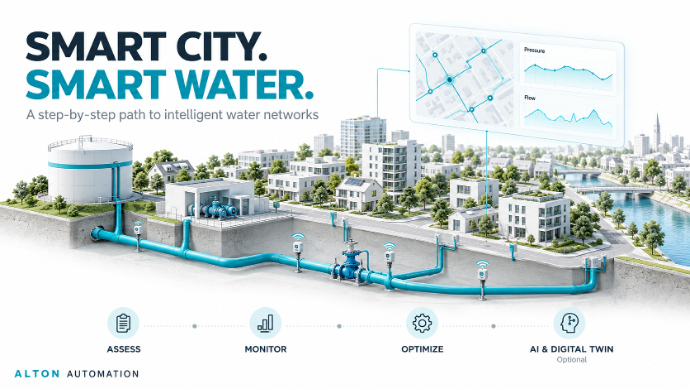
In many cities — large and small — the water distribution network was designed decades ago and offers no real-time view of its own condition today: pressure, flow, pump status and losses all stay unknown until a problem shows itself as a visible failure, a customer complaint, or a bill nobody can explain. Digitalizing such a network from scratch does not require one large, sudden leap. At Alton Automation, we take this ‘Smart City, Smart Water’ journey step by step, so that every investment delivers a visible, measurable result before the next one is made — whether the network belongs to a small town or a major city.
Why the Starting Point Is SCADA
Building a smart water network from scratch starts with a central monitoring and control platform (SCADA) — without real-time visibility into the network, no optimization is possible. In the SCADA software domain, Alton partners with FlowChief, ALTON’s SCADA technology partner. This partnership lets us deliver field hardware — sensors, controllers, data loggers — and control-room software as one matched, integrated solution, rather than two separate systems that have to be connected later.
Assess — Understanding the Network Before Any Action
Before purchasing or installing any equipment, we first get to know the network well and determine the right location for every device — this avoids unnecessary costs and later relocations. This stage includes site visits to pumping stations, reservoirs and proposed sensor locations; a check of each site’s infrastructure (power supply, communication network coverage, access); and finally system design and a detailed equipment list. The output of this stage is a precise map of every point’s location and a final design that forms the basis for ordering equipment in the next stage.
Monitor — Digital Monitoring and Network Integration
To manage a network, you first have to see it. In this stage, pressure, flow, water-quality and pumping-station data arrive at one central control center in real time. It includes installing pressure monitoring stations at key points across the network to build the city’s pressure map, deploying portable data loggers to profile areas that do not yet have fixed stations, installing flow meters at zone inlets and main lines, setting up water-quality stations with automatic alarms, and connecting the city’s pumping stations to the control center through a field unit that reads pump status, pressure, flow and energy use — without any change to the existing pumps or panels. The exact quantity of each item depends on the size and complexity of each city’s network; see “Alton’s Proposed Package” below.
Delivered at this stage: a working monitoring center, a trained operations team, and — most importantly — baseline data that becomes the foundation for the next stage’s design.
Optimize — Smart Pressure Management
After a few months of real data from the Monitor stage, it becomes clear which areas carry too much pressure and which carry too little. The Optimize stage is designed from this real data, not from assumptions. Priority zones are identified — their number depends on the size of the city, though the underlying architecture is built from day one to expand to more zones without a redesign. For each zone, the “critical point” (the farthest or highest point, with the lowest pressure) is identified, a smart pressure controller is installed on the zone’s inlet valve, and a pressure transmitter is placed at the critical point to report end-of-network pressure back to the controller.
To keep customers safe, control is activated gradually, in three levels: time-based control (lower pressure during low-demand hours such as night, higher during peak hours), flow-based control (pressure follows real-time demand), and critical-point control — the most accurate method — where the controller sets inlet pressure so the critical point always has enough pressure.
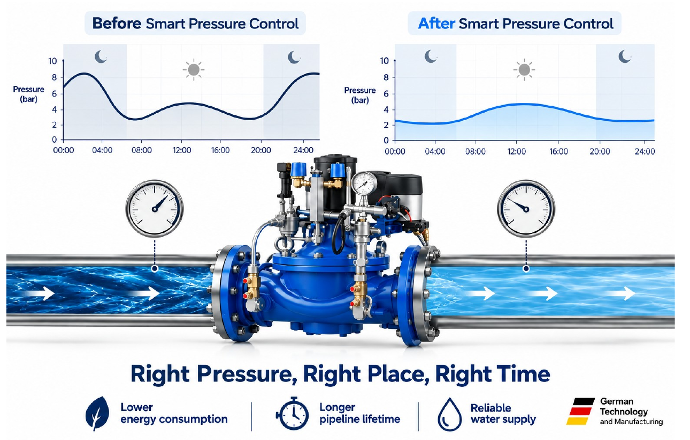
A conceptual example of how a network’s pressure pattern changes over one day, before and after smart pressure control is activated.
Each zone’s performance before and after control is compared: pressure stability, reduced excess pressure, low-pressure complaints, and loss indicators. Results are presented in management reports.
AI & Digital Twin (Optional) — From Data to Decisions
Once real data from the Monitor and Optimize stages is available, a city can — if it chooses — move to the next step: a digital twin (a live model of the network used to simulate changes before applying them in the real world) and AI-based analytics (demand forecasting, early leak and failure detection, and pump energy optimization). This stage is intentionally optional, and its scope and cost are agreed only after jointly reviewing the results of the first two stages, based on that network’s real data — not a number guessed in advance.
Alton’s Proposed Package
Depending on the size and condition of each city’s network — small, medium or large — Alton’s package for water-network digitalization typically includes the following. The exact quantity of each item (“N” below) is determined for each city individually, based on the site survey and system design described under “Assess”:
Central SCADA software— for monitoring, control, alarms and reporting; delivered through Alton’s partnership with FlowChief.
Control-room hardware— servers, network equipment, network security, control-room monitors and accessories.
N pressure transmitters, data loggers and network edge units— to build the city’s pressure map.
N water-quality monitoring units— connected to the network, measuring chlorine, turbidity, pH and conductivity.
N flow meters— connected to the network, at zone inlets and main lines.
N energy meters and pump status transmitters— to monitor pumping-station status and connect them to the network and SCADA.
N reservoir level transmitters— to monitor the level of storage and supply reservoirs.
N smart pressure controllers (Smart PRV)— for the Optimize stage.
Engineering services— system design, integration, and installation supervision and commissioning support.
Training and knowledge transfer— for the local operations and maintenance team.
Remote technical support— after commissioning and handover.
This package forms the technical backbone of the Monitor and Optimize stages; in the optional AI & Digital Twin stage, a software layer is added on top of this same infrastructure, with no change to the hardware architecture.
Why Step by Step Beats One Big Leap
A phased approach has several clear advantages: every stage delivers a visible, verifiable result before the next investment decision; the risk of building more infrastructure than a city actually needs is reduced; later stages are designed on that network’s real data rather than generic assumptions; and local teams build the capability and confidence to operate the system independently, through training built into every stage. Because baseline network data is not available before the Monitor stage is implemented, no specific percentage for loss reduction or savings is promised at this point; performance indicators are agreed with the client after the Monitor stage, based on that network’s real data.
What This Path Delivers for a City
The result of this roadmap for a city is a complete view of network conditions in one center; an understanding of demand patterns in every zone; fast alerts when water quality changes unexpectedly; more stable pressure with fewer fluctuations, especially in low-pressure areas; lower excess pressure during low-demand hours, meaning less stress on pipes and a lower risk of bursts; the data needed to identify high-loss areas; a faster response to sudden pressure drops or surges; and data-driven decisions for prioritizing future investment. Most importantly, this path builds a scalable infrastructure that can also serve as the foundation for future smart-city projects.
Conclusion
Building a smart water network does not require one large, sudden leap, nor does it require starting from numbers no one can yet verify. What it requires is a clear, step-by-step roadmap — one where every stage delivers a visible, measurable result. At Alton Automation, together with our SCADA technology partner, FlowChief, we help cities and water utilities — regardless of their size — design this roadmap based on their own network’s real data.
If your city or water utility is looking for a roadmap like this, the Alton team is ready to assess your network. See our full range of solutions at altonautomation.de/solutions, or get in touch through altonautomation.de/contact.