
Dynamic Pressure Control: A Practical Path to Reducing Non-Revenue Water
How intelligent pressure management turns a global water-loss problem into a measurable, fundable improvement
Every year, water utilities lose a significant share of what they treat and pump before it ever reaches a paying customer. This is non-revenue water (NRW): water produced and treated, then lost to leaks, bursts, theft, or inaccurate metering before it is billed. The map below shows just how widespread the problem is — non-revenue water above 40% is common across large parts of the world, and even well-developed economies struggle to keep it under control.
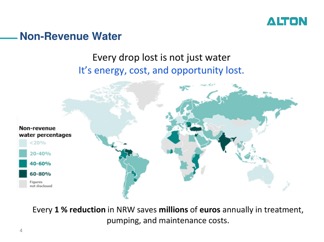
Non-revenue water as a share of water supplied, by country. Source: Alton Automation, compiled from public utility and government data.
The pattern is clear — and so is the opportunity. Every 1% reduction in NRW saves a utility millions of euros a year in treatment, pumping, and maintenance costs spent producing water nobody ever paid for.
Water Loss Is a Global Challenge, Not a Regional One
National averages hide how differently utilities perform even within similar economies. Germany, one of Europe’s most efficient networks, loses just 7.9% of the water it distributes. Italy, despite advanced systems, loses 42.4%. Saudi Arabia’s non-revenue water is estimated at around 30%, varying by region. South Africa’s national average stands at 47.3%, equivalent to roughly 3 billion cubic meters of water lost in a single year. Peru’s national average is 38.5%, valued at S/345.7 million in 2024. The gap between the best- and worst-performing utilities is not primarily about climate, income level, or even network age — it is about how actively pressure is managed.
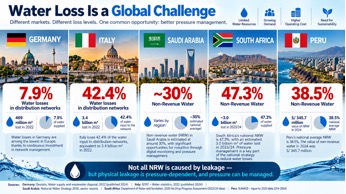
Water losses across five national networks. Sources: Destatis (Germany), ISTAT (Italy), Saudi Arabia National Water Strategy 2030, South Africa Department of Water and Sanitation (2026 No Drop Progress Assessment), SUNASS (Peru).
Three Ways Utilities Fight NRW
Utilities generally attack non-revenue water from three directions: finding and repairing leaks faster, metering water accurately so losses become visible, and managing network pressure so fewer leaks and bursts happen in the first place.
The first two depend on detecting problems that have already happened. The third — pressure management — prevents many of them from happening at all. It is also where Alton Automation has built its core expertise.
Dynamic Pressure Management: Why It Works
Most of a network’s physical losses are driven directly by pressure. A traditional pressure-reducing valve (PRV) holds the network at one fixed pressure around the clock — sized for the handful of peak-demand hours — which means the network runs at unnecessarily high pressure most of the day, and especially at night, when demand (and the pressure actually needed) is lowest.
Dynamic pressure control changes this by continuously adjusting pressure at the PRV to match real, measured demand. International benchmarks show that effective dynamic pressure control reduces physical losses by 15–30%, and European utilities using optimized systems have achieved 10–20% NRW reduction within 12–18 months. As a rule of thumb, each 1 bar reduction in average network pressure lowers leakage by roughly 12–15%.
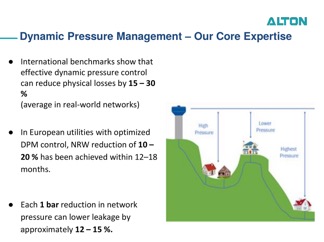
Dynamic pressure control keeps the network at only the pressure it needs, point by point across the terrain.
Proven in the Field
Alton’s Smart Valve Controller builds on more than 10 years of experience digitalizing pressure-reducing valves — from simple manual valves, to hydromechanical PRVs, to today’s fully digitalized, remotely monitored controllers. The system is already deployed and operating in real networks, continuously logging pressure, flow, and valve condition data.
Only the Pressure You Need — Not a Bar More
The difference between a fixed PRV and a smart, dynamically controlled one is best seen side by side. A traditional valve holds a flat pressure through the night, even when demand has dropped to a fraction of its peak. A smart controller follows actual demand instead — lower at night, higher only during peak hours — keeping the network at only the pressure it needs at any given moment.
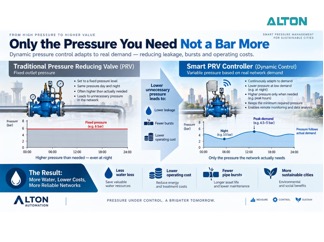
Traditional fixed-pressure PRV operation compared with Alton’s dynamic, demand-based control.
The result reaches beyond water savings. Utilities see fewer pipe bursts and emergency repairs, meaning fewer unplanned service interruptions and a more consistent, more trustworthy supply for customers — pressure instability, not just outages, is one of the most common sources of customer complaints. At the same time, pipes, joints, and valves held within a narrower, well-managed pressure range fatigue more slowly, extending the working life of infrastructure already in the ground and reducing the capital and emergency-repair costs that aging networks otherwise demand.
The Economic Case
Reducing NRW pays for itself quickly almost everywhere, even without a country-specific case study. International benchmarks tell this story on their own: effective dynamic pressure control typically cuts physical losses by 15–30%, and utilities running optimized systems have reported 10–20% reductions in NRW within 12–18 months of deployment. Because every 1% reduction in NRW can save a utility millions of euros a year in treatment, pumping, and maintenance costs, that scale of improvement is consistently enough to recover the cost of a pressure-management investment well within its first one to two years of operation — and to keep paying back for the 15+ year working life of the equipment that follows.
The exact payback period for any given network depends on variables only the utility itself can supply accurately: current leakage volume, local water tariff, energy costs, and the scope of the installation. As a simple starting point:
Payback (months) ≈ Investment cost ÷ (Annual water volume saved × local water tariff)
We’re glad to work through this calculation for a specific network together, using real local tariff and loss data — rather than publishing a generic example that may not reflect your situation.
A Realistic Starting Point
Reducing NRW to zero isn’t realistic for any network. But closing even part of the gap between a 7% network and a 40% network is achievable with a focused toolkit: pressure and level monitoring, automated PRV control, and the data visibility to see where a network is losing water before it becomes a visible failure. This is the combination Alton Automation builds into its Smart Valve Controller and water-network automation solutions.
Learn more about Alton’s Smart Control Valve and the full range of water-network automation products at altonautomation.de/products, or see how these solutions fit into a complete water-management strategy at altonautomation.de/solutions.